Prentisstown’s boys-to-men social rule
The Knife of Never Letting GoPrentisstown’s boys-to-men social rule marks thirteen as the boundary between boyhood and manhood, then enforces that boundary through separate social worlds. At first, the division appears to be an age custom; the later revelation that boys must kill to become men exposes it as a means of concealing and reproducing the town’s collective violence.
The age boundary and social separation
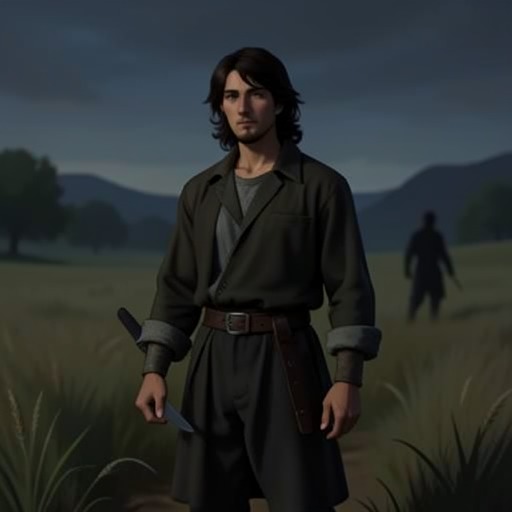
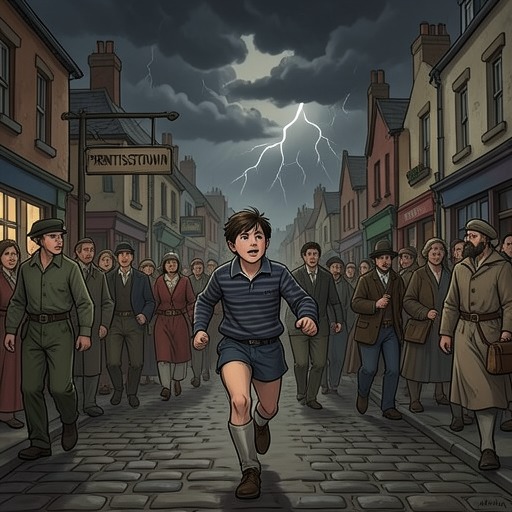
Todd Hewitt is the youngest person in Prentisstown. He remembers throwing rocks at crows with older boys, including Seb Mundy, but as those boys turn thirteen they stop speaking to him. The rule is categorical: boys who reach that age become men, and men attend meetings from which boys are barred.
The separation leaves Todd waiting on his own. His childhood companions have crossed into the adult group, while he remains outside its conversations and decisions. That isolation is especially stark because he is the last boy in town: there is no younger cohort to share the wait with him.
Explanations for becoming a man
When Viola asks why the town makes boys become men at thirteen, Todd gives two explanations he has heard. Aaron described the age as scriptural, associating it with eating from the Tree of Knowledge and passing from innocence into sin. Ben offered a practical account: on an isolated planet with a small population, the community needs adults and assigns real responsibilities from thirteen onward.
The calendar gives the threshold a precise form: thirteen years, each made up of thirteen months. Yet neither the religious symbolism nor the practical explanation accounts for what the rule actually requires in Prentisstown. Their contrast with the later truth shows how a familiar age custom and its public justifications obscure the violence built into the town’s definition of adulthood.
The concealed coming-of-age rite
Todd eventually identifies the reason boys who have become men do not speak to boys who are still boys: the separation keeps the town’s killing rite from the children who have not yet undergone it. Mr Royal, Todd’s former schoolteacher, was not lost to suicide as the town’s account suggested. Seb Mundy killed him on Seb’s thirteenth birthday, alone in the act while Prentisstown’s men watched.
The same pattern shaped Mr Gault’s death. After he tried to flee through the swamp, Mayor Prentiss arranged for Mr Prentiss Jr to kill him on the boy’s thirteenth birthday. The rite could use a captured escapee; if no such person was available, the men could choose someone in town they disliked and claim that he had disappeared. In either case, one man’s life was assigned to a boy to end without help from the others.
Complicity and the meaning of adulthood
The division between boys and men is therefore not simply a rule about age or access to meetings. It gives the men a protected sphere in which they can plan, witness, and perpetuate the rite, while keeping younger boys ignorant until their own turn arrives. The men’s silence toward boys becomes part of a larger system of enforced complicity.
Todd’s discovery changes the meaning of the rule: manhood in Prentisstown is made conditional on killing, and the men’s presence makes them participants even when a boy performs the act alone. Todd recognizes the pattern in the deaths of people he knew and concludes that the adult men are guilty together. His claim of exception distinguishes him from the system he has uncovered: he has learned what the town demands, but does not accept its demand as the measure of becoming a man.